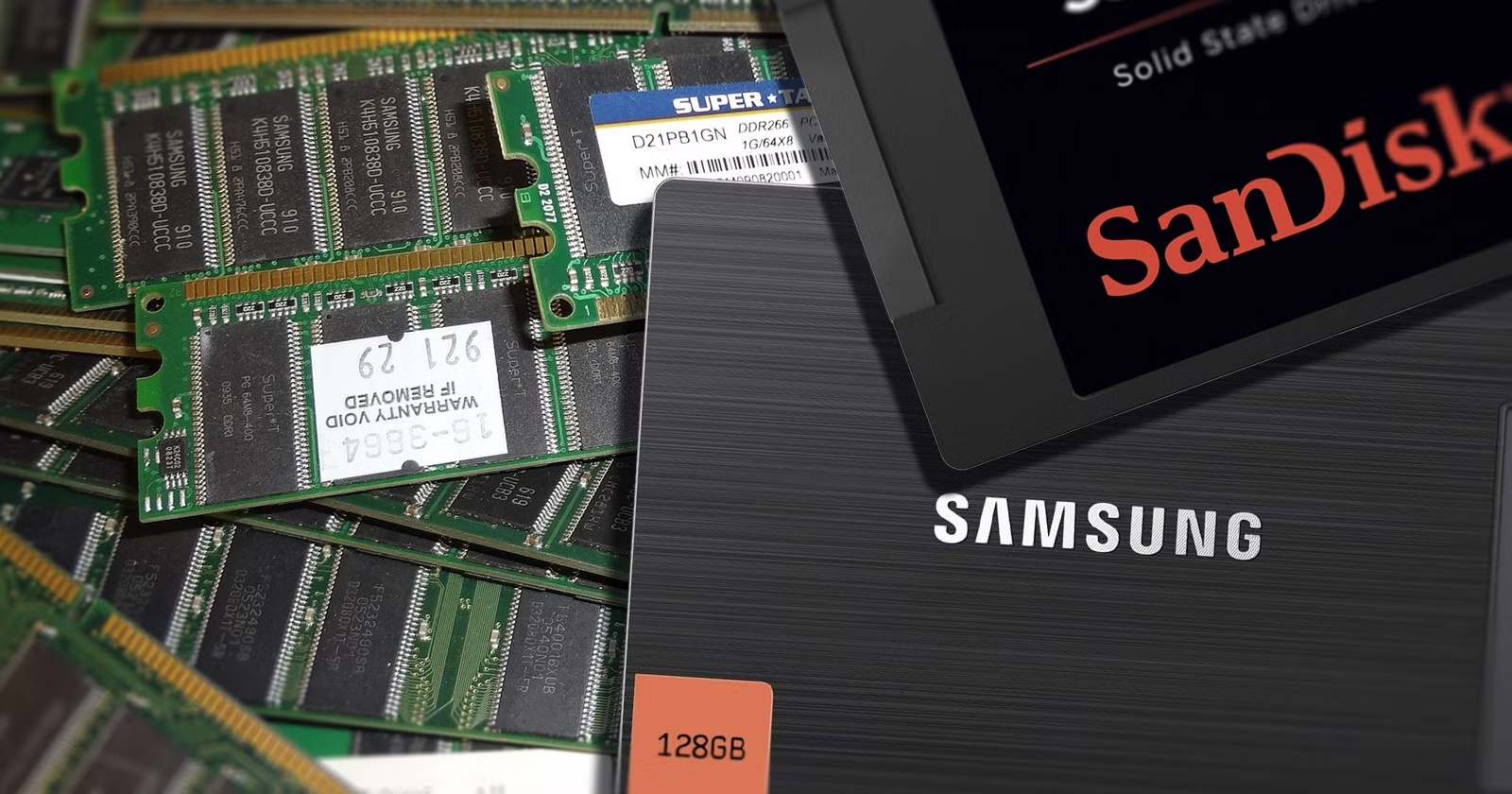
Storage could get relief before system memory does. TrendForce expects NAND Flash contract prices—the pricing that matters upstream for SSD makers—to start declining as early as the first quarter of 2027, with broader reductions expected in the second quarter. DRAM prices may take longer to turn, particularly if AI data-center spending remains strong.
For tablet and laptop buyers, the forecast is a useful sign rather than a promise of cheaper retail hardware. TrendForce is tracking contracts negotiated between memory manufacturers and industrial customers, not the shelf prices of SSD upgrades, DDR5 kits, or finished mobile devices. Any decline would need to work through component suppliers and device makers before it appears in consumer pricing.
Two paths for memory pricing
TrendForce modeled DRAM under two demand scenarios tied to AI data-center investment. In its baseline case, price increases gradually cool through 2027 before DRAM may stabilize in the second half of the year and decline in the first quarter of 2028. If AI-related demand weakens, DRAM reductions could begin in the fourth quarter of 2027 instead.
| Period | DRAM: baseline scenario | DRAM: weaker AI-demand scenario | NAND Flash / SSDs |
|---|---|---|---|
| Q4 2026 | Prices rise | Prices rise | Prices rise 8%–13% |
| Q1 2027 | Price increases moderate | Not separately forecast | Prices fall by up to 5% |
| Q2 2027 | Price increases moderate | Not separately forecast | Prices decline across categories |
| Q3 2027 | Possible stabilization | Not separately forecast | Prices continue to decline |
| Q4 2027 | Possible stabilization | Price declines begin | Prices continue to decline |
| Q1 2028 | Price declines begin | Sharper price declines | Not separately forecast |
The forecasts cover quarterly contract-price movement, not retail pricing. TrendForce’s November 19 and November 27, 2026 reports underpin the outlook.
Supply growth could change the balance
The potential NAND reversal rests on a supply-and-demand shift. TrendForce estimates NAND Flash bit output could grow 25% to 30% in 2027. If that added capacity arrives as demand moderates, the market could move from shortage conditions toward oversupply, creating more room for SSD contract prices to fall.
There are already signs that demand is becoming less uniform. Chinese cloud-service providers reportedly began cutting memory order volumes in October, although U.S. buyers absorbed much of the inventory that became available. Data-center expansion also faces power-grid constraints, while U.S. restrictions on Chinese companies’ access to AI chips and potential changes in NVIDIA funding for cloud providers could affect future investment plans.
Older memory and NAND products have shown early weakness on the spot market. TrendForce reported that DDR4 chip prices fell 1.61% in one week, while 512Gb TLC NAND wafers declined 3.18%. Spot-market movement can be volatile, but it suggests buyers are becoming less willing to absorb continually higher component costs.
The practical takeaway for mobile-computing shoppers is that storage costs may ease before RAM costs do, if TrendForce’s supply assumptions hold. It remains too early to predict U.S. SSD, laptop, tablet, or phone prices, and a slowdown in increases would not necessarily restore the lower pricing seen before the memory shortage.
Post Footer automatically generated by Add Post Footer Plugin for wordpress.