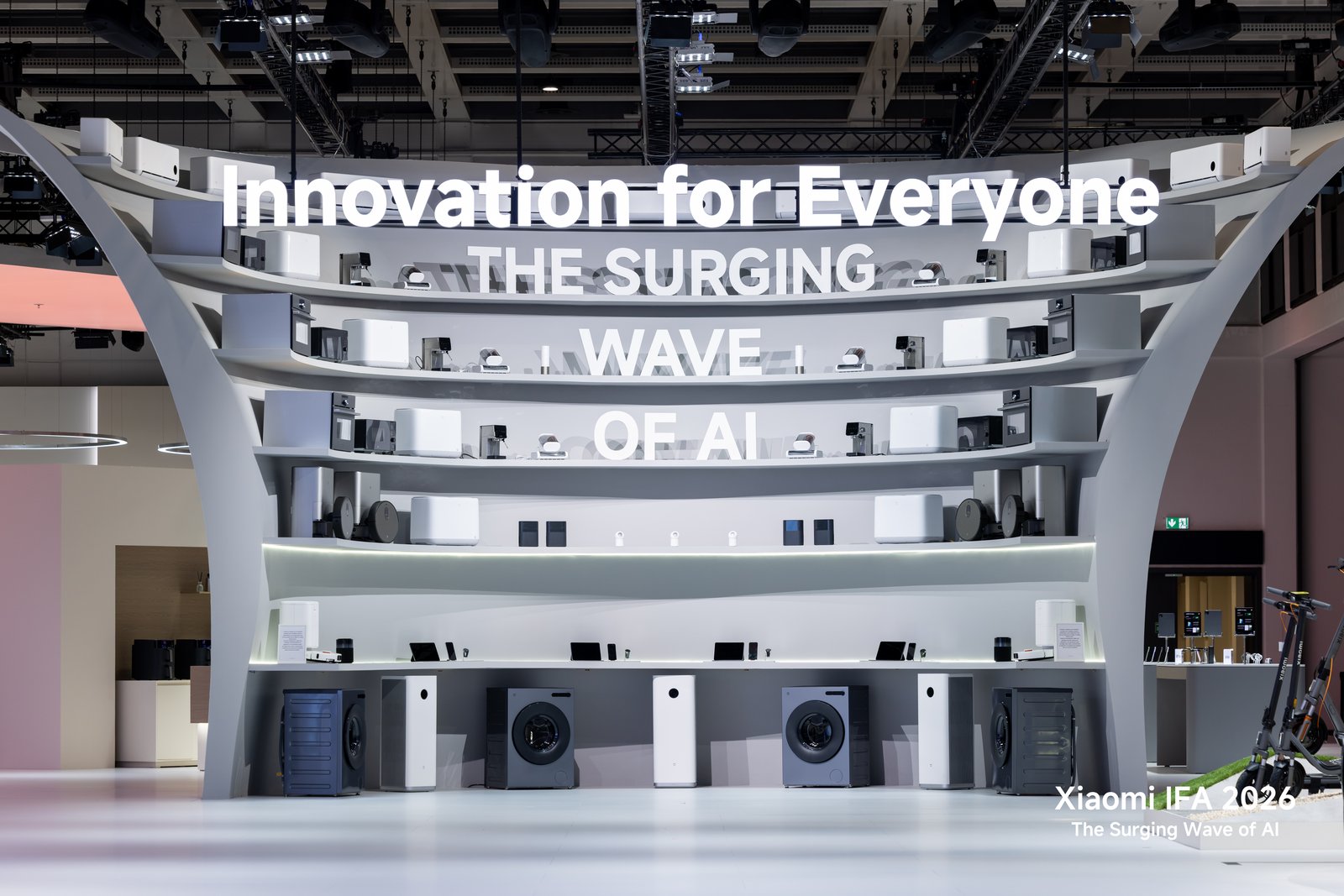
Xiaomi’s IFA 2026 presentation was less about a single gadget than a plan to make its mobile software the control layer for a much larger collection of devices. At a more than 3,300-square-meter exhibit in Berlin, described by the company as its largest stand ever outside China, Xiaomi brought together over 380 products under its Human × Car × Home ecosystem.
The central promise is that HyperOS can move beyond linking screens and accounts to coordinate actions in the physical world. Xiaomi demonstrated AI-driven scenarios in which devices can interpret context and carry out multistep commands across a home or vehicle, including adjusting home climate controls as a user heads home. The company says the system is intended to reduce the need for manual, device-by-device controls.
A foldable and in-house AI hardware

For portable-device users, the Xiaomi 18 Fold was among the event’s most notable hardware announcements. Xiaomi identifies the flagship foldable as the first device powered by its next-generation, internally designed XRING O3 processor. The company did not provide specifications, pricing, or U.S. availability details in the information presented here.
Xiaomi also highlighted its MiMo-V2.5-Pro, Xiaomi Miloco, and Xiaomi Miclaw AI models, describing them as additions aimed at more advanced reasoning and task execution. Alongside those software efforts, the company showed its CyberOne humanoid robot interacting with visitors. Xiaomi says CyberOne is already being tested in real automotive-production scenarios.
Mijia and the wider connected-home push

The connected-home side of the presentation included plans to officially distribute more than 2,000 Mijia products across 130 categories in Europe. The expansion, presented under the “The Art of Smart Living” branding, would give Xiaomi a broader hardware base for the cross-device experiences it is promoting through HyperOS.
Xiaomi backed up that ecosystem pitch with scale figures for its AIoT platform: more than 1.1 billion connected devices globally and over 175 million households served. It also pointed to its manufacturing operations, including a Wuhan factory said to assemble an air conditioner every 6.5 seconds and robotic lines where humanoid robots assist with complex assembly work.

Cars remain part of the company’s longer-term ecosystem story. Xiaomi brought the virtual Xiaomi Vision Gran Turismo hypercar concept, the production Xiaomi SU7, and the high-performance SU7 Ultra to IFA. It has also outlined plans for its automotive division to expand in Europe in 2027, though the presentation does not establish availability in the United States.
To fund its work across chips, on-device AI, operating systems, robotics, and European retail and service networks, Xiaomi says it plans to invest more than €24 billion in global research and development between 2026 and 2030. For U.S. mobile-computing buyers, the immediate relevance hinges on whether devices such as the Xiaomi 18 Fold reach the market; Xiaomi’s IFA message for now is chiefly about building a tightly connected platform around them.
Post Footer automatically generated by Add Post Footer Plugin for wordpress.