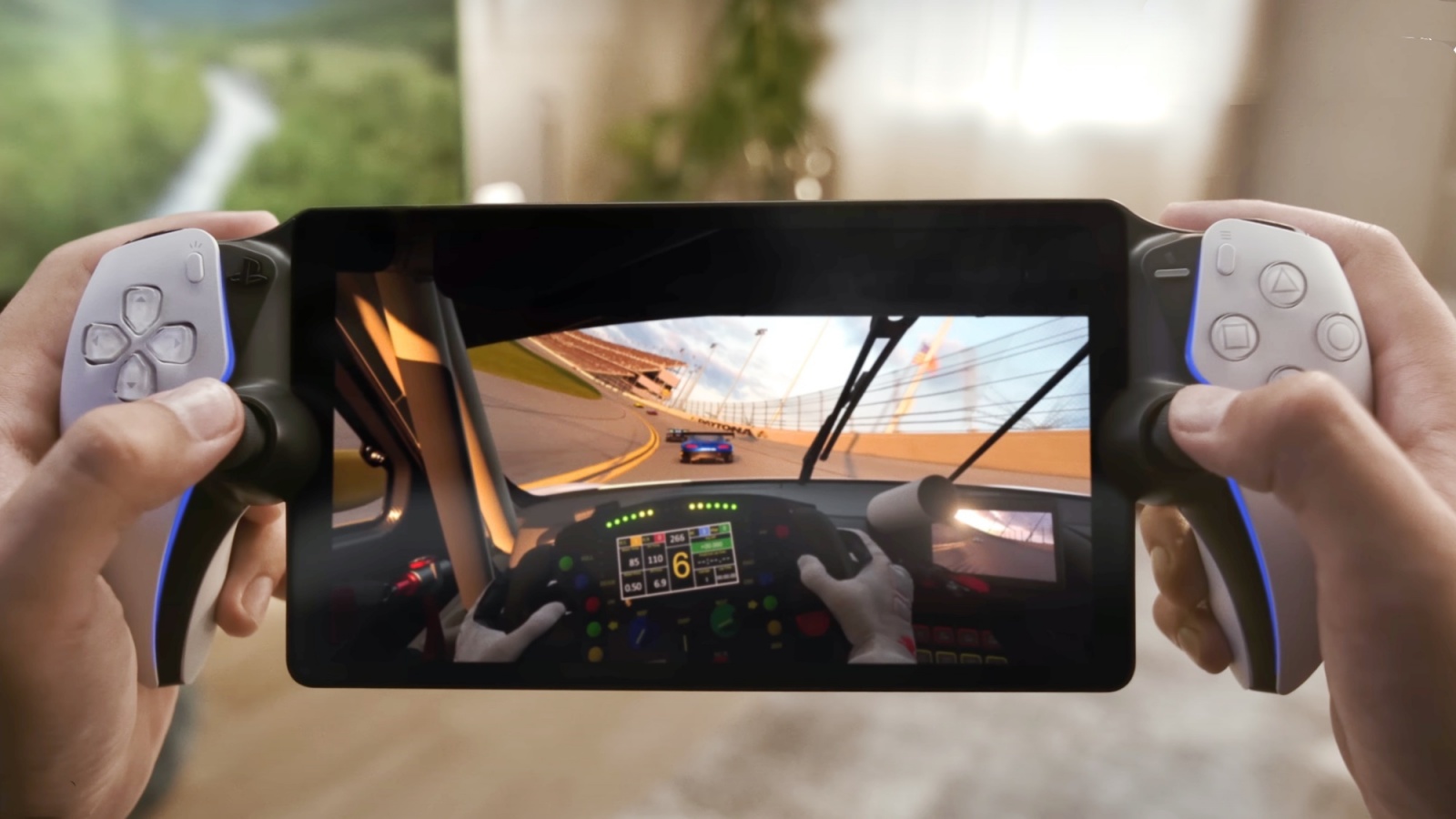
The most consequential claim in a new Project Canis leak is not its rumored processor configuration—it is the proposed rendering strategy. Sony’s alleged next PlayStation handheld could render games at 540p, then use a future version of PlayStation Spectral Super Resolution (PSSR) to reconstruct an image for a 1080p portable display.
That approach would make sense for a battery-powered gaming device with a reported 15W to 25W power budget. Rather than attempting to match the raw output of a living-room console, Canis would depend on upscaling and frame generation to make demanding games workable in a smaller, lower-power form factor. Sony has not confirmed the project, its specifications, the “PSSR 3.0” name, or a release window.
A rumored AMD platform built for portable power limits
The leak describes Canis as a separate handheld platform associated with PlayStation 6, powered by a 3nm AMD chip. Its reported hardware centers on four Zen 6c CPU cores, two Zen 6 LP cores, 24GB of LPDDR5X memory on a 192-bit bus, and a 16-compute-unit RDNA 5 GPU.
In handheld mode, the GPU is said to run at 1.2GHz for 4.91 TFLOPS of FP32 compute. Docking the system could raise the clock to 1.65GHz and 6.75 TFLOPS. Those are substantially different constraints from a PS5 Pro, whose reported load power sits around 215W to 240W. The trade-off would be lower internal resolution, with image reconstruction carrying more of the visual workload.
| Specification | PlayStation 5 Pro | Rumored Project Canis |
|---|---|---|
| CPU | Zen 2 cores | 4 × Zen 6c + 2 × Zen 6 LP |
| GPU | 60 CUs, custom RDNA 2/3 architecture, about 2.18GHz | 16 RDNA 5 CUs, 1.2–1.65GHz |
| Memory | 16GB GDDR6 + 2GB DDR5 | 24GB LPDDR5X, 192-bit bus |
| Reported power under load | About 215–240W | 15–25W |
| Rendering target | 1080p/1440p to 4K | 540p to 1080p |
| FP32 compute | 16.7 TFLOPS | 4.91 TFLOPS handheld; 6.75 TFLOPS docked |
| Upscaling | “PSSR 2.0,” according to the source | “PSSR 3.0” plus frame generation, according to the leak |
Why the TFLOPS comparison needs caution
A comparison published by GameGPU assigns Canis an estimated “effective PSSR performance” of 10–11 TFLOPS in handheld mode and about 14 TFLOPS while docked. Those figures are estimates of the benefit attributed to upscaling and frame generation, not additional physical GPU compute power.
PSSR cannot turn a 6.75-TFLOPS GPU into a 14-TFLOPS GPU. What reconstruction can do, if the implementation is effective, is build a higher-resolution-looking image from fewer rendered pixels. Frame generation can also change perceived motion smoothness, though it is not a substitute for native rendering performance. Sony already uses PlayStation Spectral Super Resolution on PS5 Pro and reportedly introduced an improved version of the algorithm in 2026 through its Project Amethyst work with AMD.
For a Full HD handheld screen, 540p-to-1080p reconstruction could be a pragmatic compromise—provided image quality and frame-rate stability hold up in real games. A late-2027 debut has been suggested, but that timing remains unverified, as do the hardware configuration, clock speeds, and branding. If Canis is real, it appears aimed at players who want a more capable native PlayStation portable rather than a pocket-size replacement for PS5 Pro.
Post Footer automatically generated by Add Post Footer Plugin for wordpress.