Huawei’s Mate XT 2 Ultimate Design is built around a change that matters as much as any processor or camera upgrade: its flexible display now folds inward rather than wrapping around the outside of the device. For a tri-fold intended to open into a tablet-like 10.2-inch screen, that architecture should leave the foldable panel better protected while the phone is closed.
When fully unfolded, the Mate XT 2 provides a 10.2-inch 3K OLED panel with an adaptive LTPO refresh rate from 1Hz to 120Hz. Closed, it uses a separate 6.5-inch exterior display, which houses the front camera and face-authentication sensors. Huawei also says the outer panel has a layer designed to improve off-angle visibility.
Despite the multi-panel construction, Huawei lists the device at 3.5mm thick when open and 299 grams. The company calls it its lightest tri-fold smartphone to date. IP58 and IP59 dust- and water-resistance ratings are also part of the package, an important addition for a device with a more complex folding mechanism.

A portable tablet format with new silicon
The Mate XT 2 launches the Kirin 9050 Pro, built around what Huawei calls a LogicFolding architecture. Huawei claims a 46% performance increase over the Kirin 9030 Pro, though it has not provided the testing details behind that comparison. Every announced configuration includes 16GB of RAM, with storage ranging from 256GB to 2TB.
A 5,600mAh battery supplies the device, with support for 66W wired charging and 50W wireless charging. It runs HarmonyOS 7, which Huawei says expands its focus on AI through local AI-model operation, content generation, improved multitasking, and an upgraded Celia assistant. The software also adds new visual treatments for volume and brightness controls.
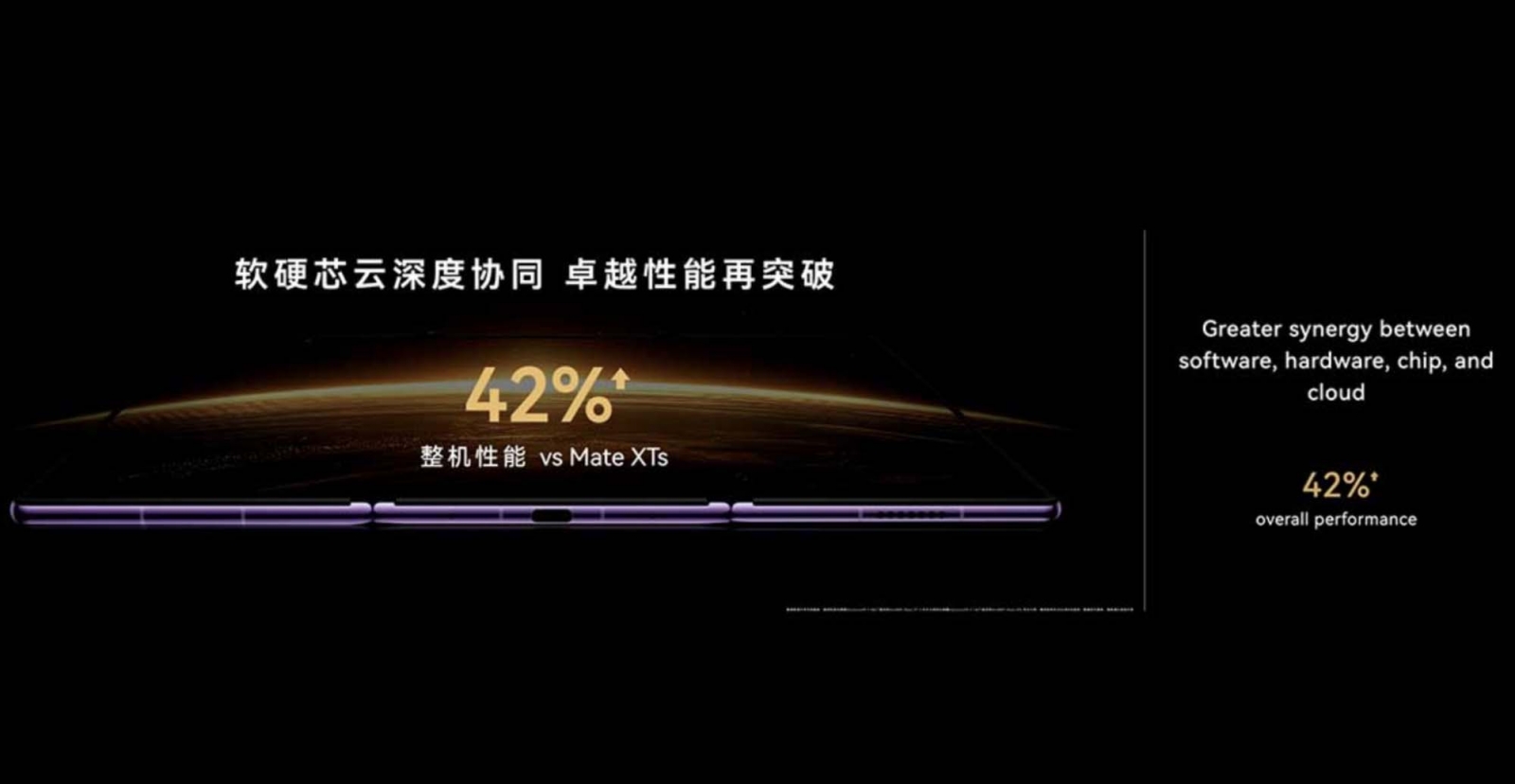
For people who want a large screen for documents, multitasking, or media without carrying a separate tablet, the key promise is a tablet-sized canvas that can collapse into a more conventional phone format. The revised folding system is the more consequential generational change from the original Mate XT Ultimate Design, whose outward-folding arrangement left part of its flexible screen exposed.
Camera hardware and a privacy-focused option

Huawei retains the octagonal rear camera module associated with its Ultimate Design line. The main camera is a 50-megapixel unit with a 1/1.28-inch RYYB sensor, optical image stabilization, and a variable aperture. It is joined by a 40-megapixel ultrawide camera, a 50-megapixel periscope telephoto camera with 3.5x optical zoom, and a True-to-Color multispectral sensor. There are also 8-megapixel selfie cameras on both the inner and outer displays.
One upper-tier version adds Privacy Display technology, intended to make on-screen content harder to view from the side. That could be useful for working with messages and documents in crowded places, although Huawei has not detailed how the feature affects image quality or viewing angles during everyday use.
China pricing and availability

The Mate XT 2 Ultimate Design is initially available in China. Reported China pricing, expressed as approximate euro equivalents, starts at about €2,565 for the 16GB/256GB model, rises to roughly €2,822 for 16GB/512GB and €3,078 for 16GB/1TB, and reaches about €3,207 for the 1TB Privacy Display version. A 16GB/2TB Collector Edition is listed at approximately €3,848.
Huawei has not confirmed U.S. availability, a U.S. launch date, or U.S. pricing. For now, the Mate XT 2 is a showcase for an ultra-premium portable-computing form factor rather than a confirmed option for American tablet shoppers; its inward-folding screen and larger battery are the upgrades most likely to define whether the second-generation design is more practical than its predecessor.
Post Footer automatically generated by Add Post Footer Plugin for wordpress.