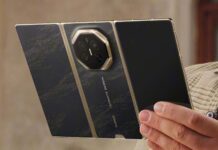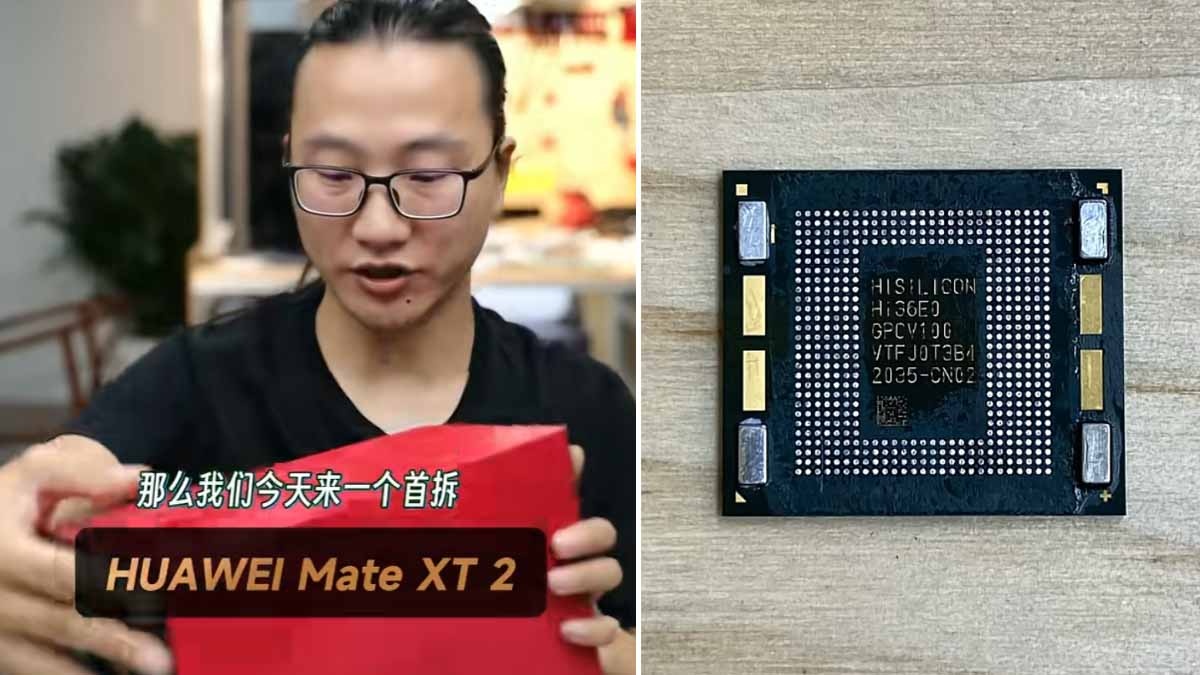
Huawei’s Mate XT 2 is built for an unusually demanding kind of mobile computing: its tri-fold design opens to a 10.2-inch internal display, where multitasking places more sustained pressure on the processor than a conventional phone layout. A new teardown of the device offers the first physical look at the Kirin 9050 Pro, the chip Huawei is positioning as the hardware foundation for that experience.
The live teardown, performed by Chinese blogger Yang Changshun before an audience of more than 100,000 viewers, exposed markings including HISILICON, Hi36E0, and 2035-CN02. The Mate XT 2 Ultimate Design is Huawei’s first phone to use the Kirin 9050 Pro, paired here with 16GB of RAM and HarmonyOS 7. Huawei claims the processor delivers a 46% performance increase over the Kirin 9030 Pro.
LogicFolding moves beyond a flatter chip layout
The larger significance is Huawei’s LogicFolding architecture, which the company calls its first implementation of the approach in a Kirin processor. Rather than arranging every logic block side by side across a flat piece of silicon, the design places some elements in layers and joins them vertically.
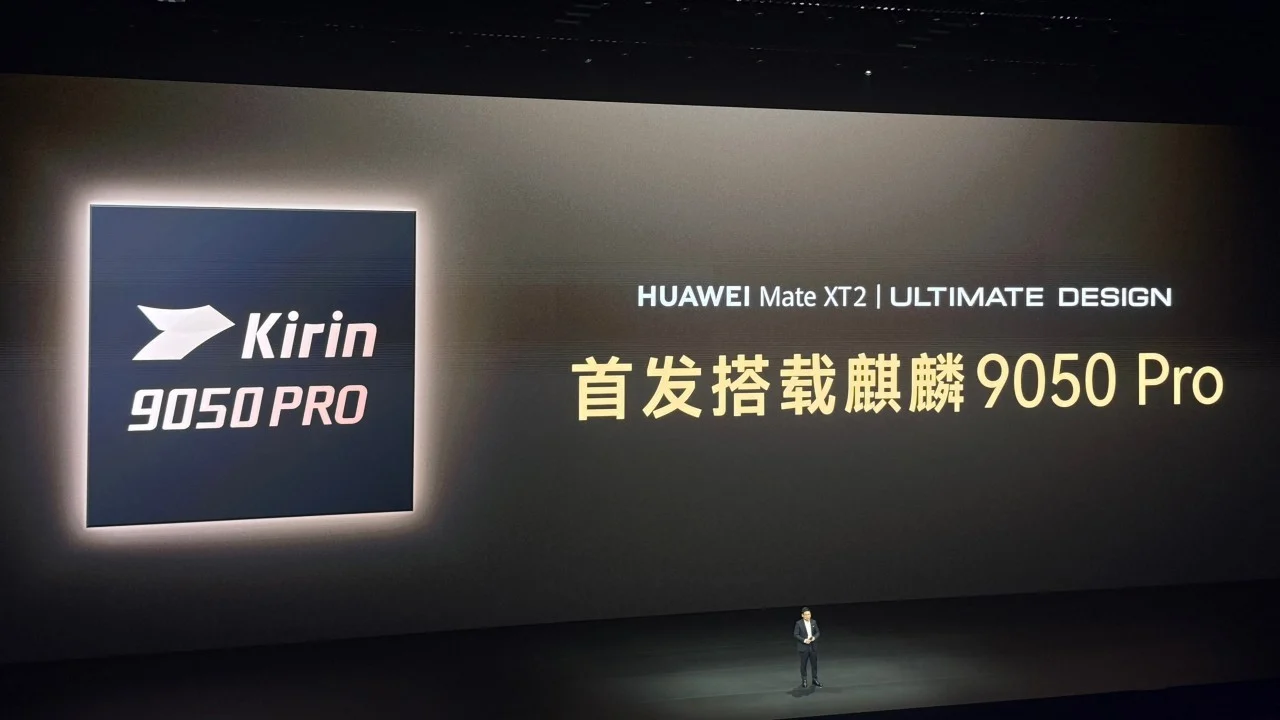
That type of organization could reduce the distance signals travel between certain chip components and increase functional density. In practical terms, Huawei is presenting it as a complementary route to performance gains when conventional scaling to smaller manufacturing nodes is not the only option. The company has also tied LogicFolding to what it calls the Tau Scaling Law.
Images from the teardown appear to show vertically arranged elements and a different interconnect structure than earlier Kirin generations. Still, a device teardown alone cannot establish the chip’s fabrication process, transistor density, or full architecture. Those answers would require more detailed disclosure from Huawei or a dedicated silicon analysis.
The “2035” marking remains unexplained

The 2035 portion of the Kirin 9050 Pro label has drawn particular attention because similar markings appeared on the Kirin 9000S, Kirin 9010, and Kirin 9020. One longstanding community theory interprets it as a reference to the 35th week of 2020, around the period when U.S. restrictions cut Huawei off from its former manufacturing supply chain.
That interpretation has not been confirmed by Huawei. The new 2035-CN02 suffix does not identify a foundry or lithography node, leaving the manufacturing process behind the 9050 Pro unresolved just as it was for several earlier Kirin chips.
For portable-computing users, the important development is less the code printed on the package than Huawei’s effort to make a large-screen tri-fold more capable through packaging and architecture changes. The Mate XT 2 shows that LogicFolding has reached a shipping device, but independent analysis will be needed to determine how much of Huawei’s claimed performance jump comes from the new physical layout versus other chip-level improvements.
Post Footer automatically generated by Add Post Footer Plugin for wordpress.