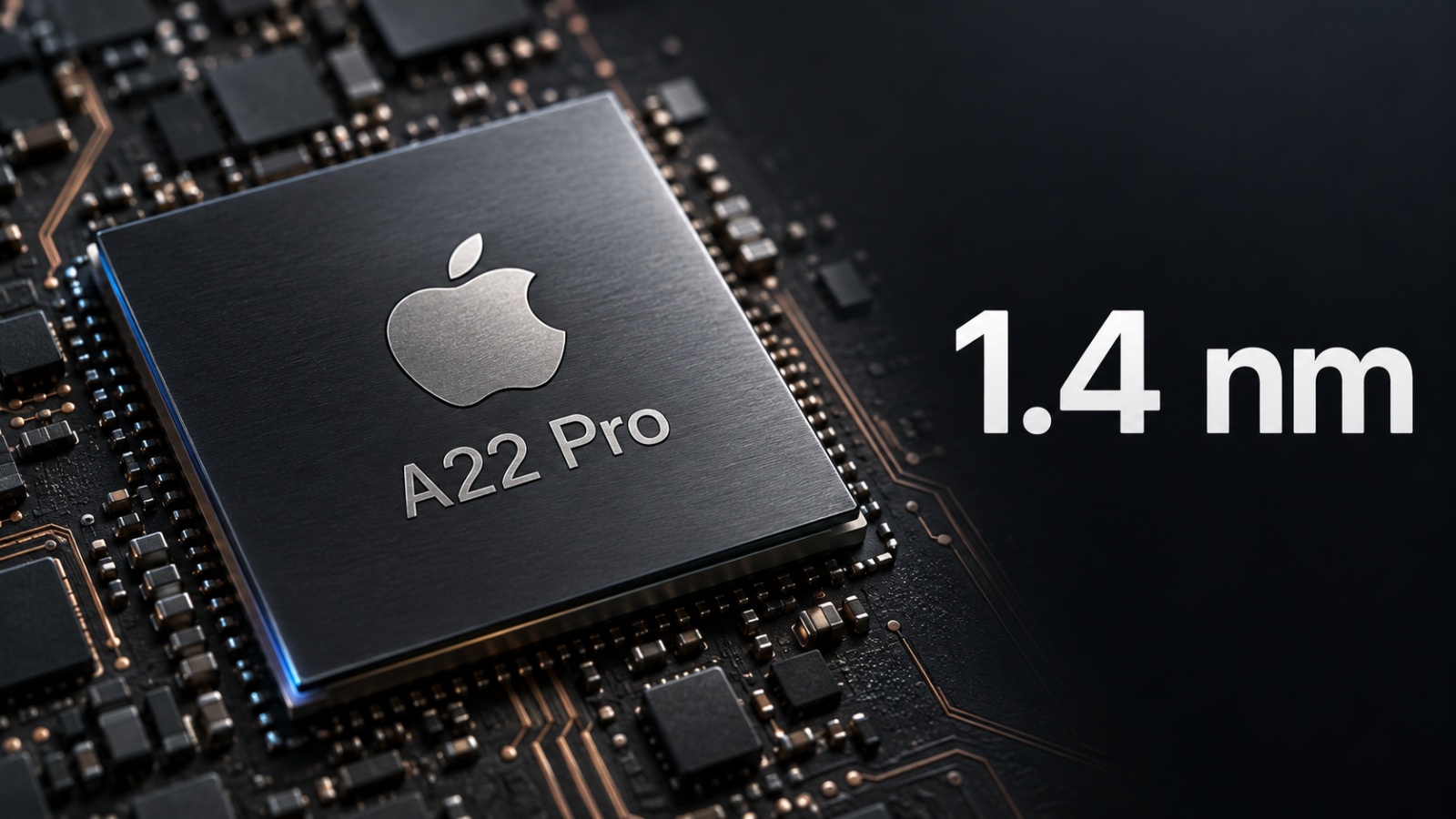
A future iPhone Pro could get a meaningful efficiency upgrade from an unusually quick manufacturing-node transition. TSMC has scheduled volume production of its A14, or 1.4nm-class, process for 2028, while TrendForce reports that Apple may use it for an A22 Pro processor in a future premium iPhone. Apple has not confirmed the chip, its process technology, or the product timetable.
For mobile devices, the most practical benefit of the new node may be power consumption rather than headline speed. TSMC says A14 can deliver up to 15% higher performance at the same power, or up to 30% lower power consumption at the same performance, compared with its N2 2nm process. That could give Apple more room for longer battery life, sustained performance, or tighter thermal limits in a phone-sized design.
| A14 claimed improvement versus TSMC N2 | Estimated gain* | What it could mean for mobile devices |
|---|---|---|
| Performance at the same power | Up to 15% | More performance within a similar power envelope |
| Power at the same performance | Up to 30% lower | Potentially improved battery life or lower heat output |
| Logic density | More than 20% higher | More circuitry in a similar chip area |
*These are TSMC process-level projections, not confirmed specifications for an Apple chip or a future iPhone.
A faster path beyond 2nm, but not a finished Apple roadmap
The reported move would follow only two iPhone generations built around 2nm technology. Apple recently adopted 2nm for the A20 Pro in the iPhone 18 series, according to the report, while the standard A22 may stay on a less costly process if the A22 Pro moves to A14. That split would let Apple reserve the newer node for higher-margin models, but it remains an industry estimate rather than a Cupertino announcement.
A J.P. Morgan note cited in the reporting suggests that A14 production could move into the first half of 2028. Pilot production is reportedly expected in the third quarter of 2027, earlier than initially anticipated. Demand for AI processors is putting pressure on TSMC capacity, while also supporting faster investment in new fabs.
Wafer costs could rise, but iPhone pricing cannot be inferred yet
Estimates for A14 wafer pricing vary widely. Some reports put a 1.4nm wafer near $45,000, compared with roughly $30,000 for a 2nm wafer. More recent estimates place A14 closer to $35,000 and N2 at about $33,000 after reported price increases. Those figures are not confirmed by Apple or TSMC.
A wafer price is not a direct measure of the cost of one device processor. The final cost also depends on chip size, manufacturing yields, defective chips, packaging technology, and how many usable processors are produced per wafer. As a result, the available estimates do not establish a future iPhone price increase.
Apple is also reportedly exploring supply-chain alternatives. Reuters reported that the company has discussed chip production with Intel and Samsung without placing orders, and that Intel could manufacture certain Apple chips beginning in 2028. TSMC is still expected to remain Apple’s primary supplier. For buyers, the bigger question is whether Apple can translate a more advanced node into noticeable battery-life and sustained-performance gains before any added manufacturing cost reaches retail prices.
Post Footer automatically generated by Add Post Footer Plugin for wordpress.