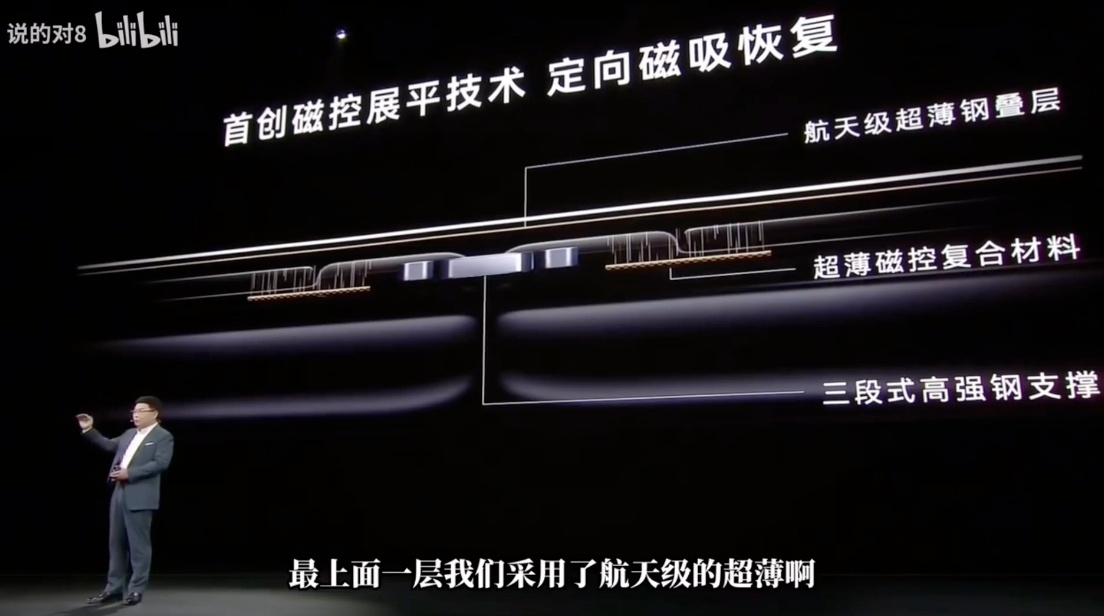
A nearly flat inner display can make a book-style foldable feel more like a compact tablet when reading, multitasking, or watching video. Huawei’s Mate X8 takes an unusual route toward that goal: rather than relying solely on the hinge and flexible glass, it uses a thin magnetic component to pull down raised areas alongside the crease after the phone is opened.
The company describes the system as correcting both sides of the deformation created by folding. A three-segment high-strength steel support structure pushes up the slight depression at the center, while directional magnetic force acts on the adjacent raised sections. Huawei says the magnetic material doubles the assembly’s return-to-shape speed.
Four parts behind the crease-control system
- Three-segment high-strength steel support: pushes upward from beneath the depressed center of the display.
- 0.1 mm magnetic composite: applies directional attraction to raised portions near the crease.
- Ultra-thin steel laminate: Huawei says its bending stiffness is improved by 140% and that it achieves a 99.9% recovery rate after bending.
- Precision 3D printing: compensates for microscopic irregularities in the support structure with 5-micron precision.
Huawei also applies a nine-layer anti-reflective treatment to the flexible screen, which it says reduces light reflection to 0.9%. Less reflected light could make small contour changes around the fold less conspicuous when the device is viewed at an angle, though Huawei’s measurements and performance claims have not been independently verified.
Huawei reports a sharp change across three generations
Huawei shared 3D scans that measure the difference in height between the highest and lowest points in the folding area. By the company’s figures, the Mate X8 reaches a 15-micron, or 0.015 mm, difference—more than 18 times smaller than the reported result for the Mate X6 two generations earlier.
| Model | Height difference at fold | Reduction versus prior generation |
|---|---|---|
| Huawei Mate X6 | 273 microns | — |
| Huawei Mate X7 | 142 microns | 48% |
| Huawei Mate X8 | 15 microns | 89.4% |
Different approaches to the same foldable challenge
Huawei is not alone in focusing on the screen’s ability to recover its shape after repeated folds, but its use of magnetic attraction is distinct among the approaches described by the companies. The broader goal is particularly relevant for foldables used as tablet-like productivity devices, where the inside panel is the main workspace.
- Huawei Mate X8: magnetic attraction works with steel supports and precision 3D printing to locally correct the display geometry.
- OPPO Find N6: uses a 3D-printed titanium hinge, a larger curvature radius, and flexible glass designed to act like a spring as the display recovers.
- Samsung Galaxy Z Fold8: uses Flex Titanium technology built around a titanium-alloy film and a titanium support plate.
The key unanswered question is long-term durability. OPPO says the Find N6 received TÜV Rheinland certification for retaining screen flatness after 600,000 folds, while Huawei has not provided an equivalent fold-cycle figure for the Mate X8 in the available materials. The Mate X8’s approach may appeal to users who prioritize an expansive, flatter-looking inner screen, but its real advantage will depend on how well that surface holds up over extended use. U.S. availability and pricing remain unconfirmed.
Post Footer automatically generated by Add Post Footer Plugin for wordpress.