OpenAI may be exploring a smartphone built around an AI agent rather than the conventional app grid, but the hardware itself has not been publicly confirmed. The latest supply-chain reports point to FIH Mobile, a Foxconn subsidiary, as a possible assembler for the company’s first phone, with a market release tentatively projected for late 2027 or sometime in 2028.
That schedule should be treated as preliminary. Neither OpenAI nor Foxconn has confirmed that a phone exists, and Foxconn reportedly did not respond to a request for comment. There is also no confirmed design, order volume, price, launch market, or U.S. availability.
A possible Foxconn-led supply chain
The reported FIH Mobile involvement would shift the expected manufacturing picture. Analyst Ming-Chi Kuo had previously named Luxshare as a potential manufacturer and projected mass production in 2028, before later suggesting that production could begin in the first half of 2027. Cailian Press also identified several Apple supply-chain companies as reportedly involved.
- FIH Mobile, a Foxconn subsidiary, is reportedly being considered for phone assembly.
- Luxshare Precision was previously identified by Ming-Chi Kuo as a possible manufacturer and has also been named in the newer supply-chain reporting.
- Lingyi iTech was named by Cailian Press as a reportedly involved Apple supply-chain company.
- AAC Technologies was also named by Cailian Press as a reportedly involved Apple supply-chain company.
The distinction between production and retail timing matters. Kuo’s estimates addressed the possible start of mass production, while the newer report’s late-2027-to-2028 window concerns when the device could reach the market. Those reports do not establish a final timetable.
An AI agent could be the central interface
Prior reports have described a phone experience centered on an AI agent that can carry out multi-step requests across connected services, rather than simply answer questions or generate text. In the hypothetical example presented in those reports, a user could ask the device to reschedule a meeting and notify attendees, provided the agent has access to the relevant calendar and messaging services.
That approach could put the software experience in direct competition with Apple, Google, and Samsung. It also leaves major practical questions unanswered: how much processing would run on-device versus in the cloud, what data permissions the agent would require, and how much control users would have over personal information. No public prototype or demonstrated feature set has been confirmed.
Rumored hardware and a separate Jony Ive device
Kuo’s earlier reporting included a prospective component set, but none of it has been confirmed by OpenAI or a manufacturing partner.
- A custom processor based on MediaTek’s Dimensity 9600 platform, reportedly built on a 2 nm process.
- LPDDR6 memory.
- UFS 5.0 storage.
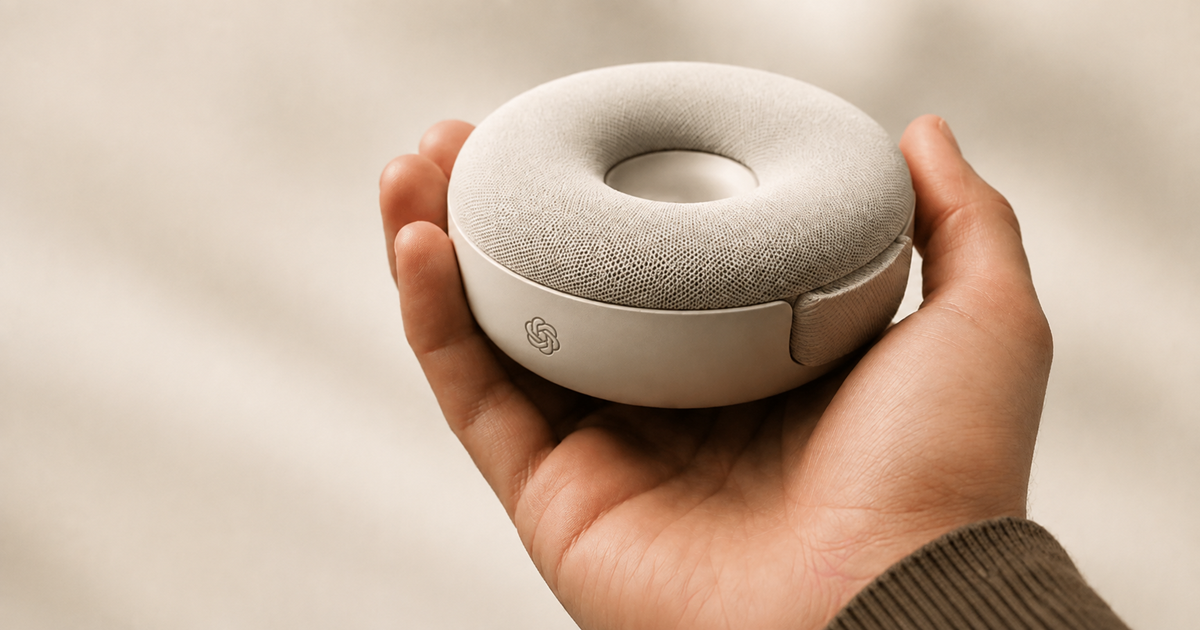
The rumored phone should not be conflated with the separate screen-free AI device OpenAI has been developing with Jony Ive. That product has been described as a puck-like companion that uses microphones, cameras, and sensors to interact with an AI assistant, rather than as a replacement smartphone. There is no confirmation that the two devices belong to the same product line or will launch in any particular order.
OpenAI does have an expanding hardware organization: the io Products team joined the company in July 2025, while Ive and his LoveFrom studio took on design responsibilities. Separately, OpenAI and Foxconn announced a collaboration in November 2025 focused on designing and preparing manufacturing for AI data-center equipment, not phones. Foxconn Chairman Young Liu later said the companies were discussing additional joint projects without identifying products.
For now, the FIH Mobile report offers a possible manufacturing path, not evidence of a finished OpenAI handset. An agent-first phone could be significant for people who want AI to handle workflows across their mobile services, but its hardware, privacy model, pricing, launch timing, and U.S. plans all remain unknown.
Post Footer automatically generated by Add Post Footer Plugin for wordpress.