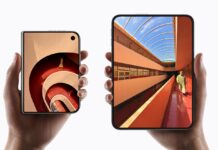
The most promising part of Apple’s iPhone Duo may not be the fold itself, but what happens while it is moving. Early hands-on videos show apps expanding from the outer display to the larger inner screen with little apparent interruption, an important test for a device meant to shift between phone-sized and tablet-like use throughout the day. In Brian Tong’s hands-on, that transition looks particularly fluid rather than like an app being abruptly moved to a second display.
A crease Apple aims to make easier to ignore
The inner display’s crease has not disappeared, but reviewers generally find it difficult to spot head-on with content on screen. It becomes more visible under light coming from the side, while the matte, nano-textured treatment appears to reduce the reflections that can draw attention to the bend in a foldable OLED panel.
UrAvgConsumer similarly found the crease effectively invisible against a bright background. Other early impressions suggest it can still be felt lightly under a finger, but is less pronounced than expected. That does not change the underlying physics of a flexible screen; it instead points to a display finish that makes the remaining visual compromise less noticeable during normal use.
iOS 27 is built around changing postures
For portable-computing users, the software behavior may matter more than the hinge. Apps appear to stretch across the larger display as the Duo opens, while games follow the same basic approach. Netflix can place video on the upper half of the partially folded device and controls below it. Messages and Photos can run side by side, with photos dragged directly between the two apps.
The early videos also show that Apple’s interface choices will not please everyone. One reviewer questioned the amount of room used by the sidebar and wanted more control over its placement. Another considered its right-side position a practical fit for thumb reach. Those differing reactions underline a core challenge for foldables: a layout that works while held open like a small tablet may feel very different in one-handed use or at an angle.
The compromises are in biometric access and cameras
Apple’s under-display FaceTime camera is almost concealed beneath the inner panel when it is not active, though its area becomes visible when the camera turns on. Early sample impressions describe its image quality as soft, with noticeable sharpening, but usable for video calls and casual captures.
Achieving an uninterrupted inner screen comes with a more consequential compromise: the Duo uses Touch ID in its side button rather than Face ID. That could be less convenient on a device intended to be opened, closed, and held in several orientations. The rear camera system is also limited to two cameras, with 2x zoom produced from the main sensor instead of a dedicated telephoto lens.
At $1,999 for 256GB, the iPhone Duo is priced as a premium foldable, so those omissions will be central to its longer-term evaluation. The early hands-ons suggest Apple’s strongest ideas are the anti-reflective inner display treatment, hinge presentation, and iOS 27’s adaptable layouts. Whether that experience outweighs Touch ID and the camera trade-offs will matter most to buyers seeking a phone that can also serve as a compact tablet.
Post Footer automatically generated by Add Post Footer Plugin for wordpress.