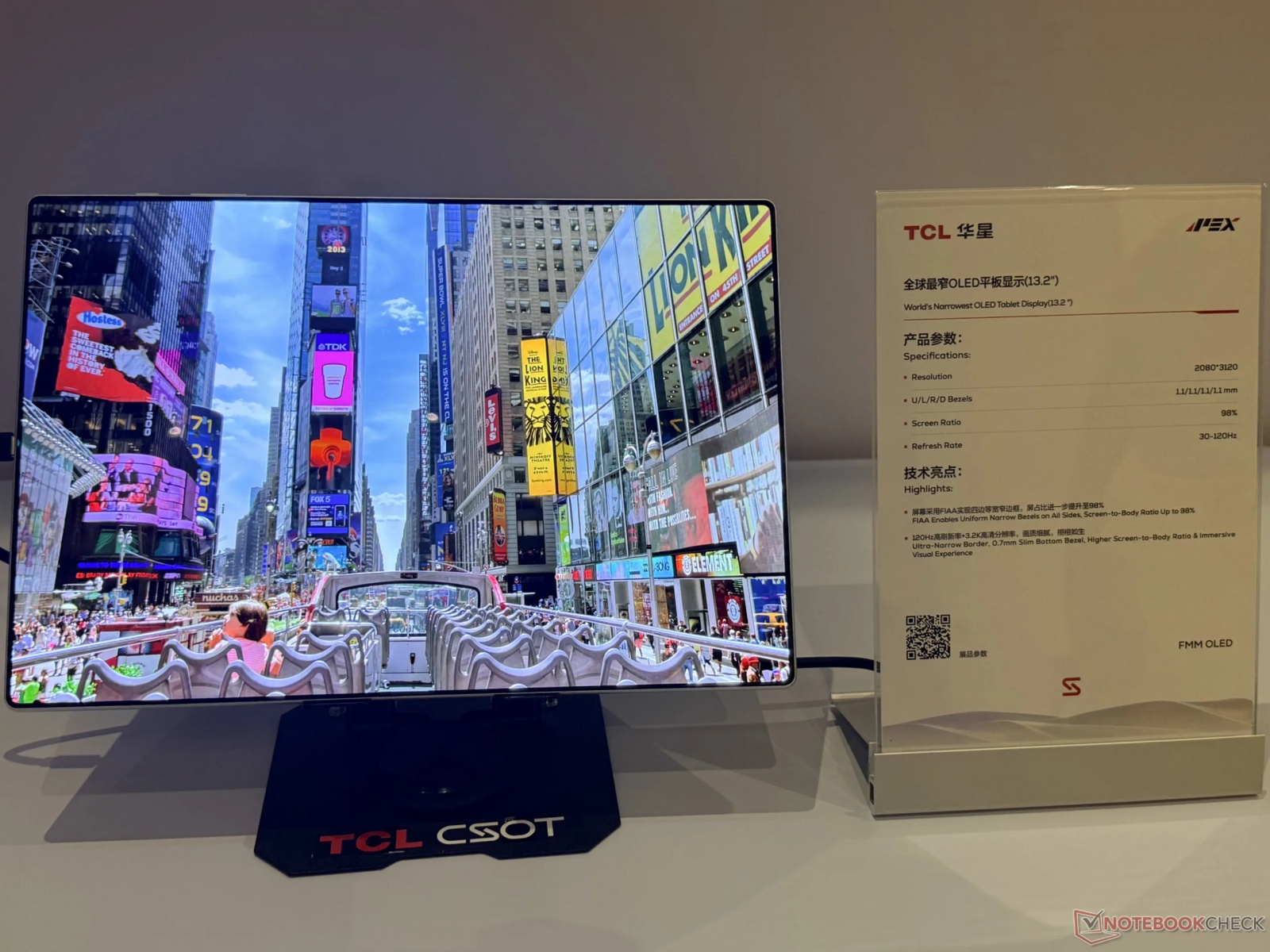
The next wave of large Android tablets could make more room for reading, streaming, and split-screen work without necessarily becoming physically larger. At its DTC 2026 event in Wuhan, TCL CSOT showed a 13.2-inch OLED prototype built around that idea: its bezels measure 1.1 mm on all four sides, producing a claimed 98% screen-to-body ratio.
The panel supports a variable refresh rate of up to 120Hz and is described as thin enough for more compact, lighter future tablets. TCL CSOT did not provide an exact thickness figure, however, and it has not disclosed the panel’s resolution, peak brightness, or color-gamut coverage. Those omissions make its image quality difficult to judge from a trade-show demonstration alone.
A narrower-bezel revision of TCL CSOT’s earlier concept
This is an evolution of TCL CSOT’s 13.2-inch OLED tablet display shown at DTC 2025. The earlier prototype had 1.7 mm uniform bezels and a 96% screen-to-body ratio, along with the ability to use different refresh rates in separate areas of the display to save power. The new design cuts bezel width by roughly 35% while increasing the claimed screen share by two percentage points.
| Feature | DTC 2025 prototype | DTC 2026 prototype |
|---|---|---|
| Panel size | 13.2 inches | 13.2 inches |
| Display technology | OLED | OLED |
| Uniform bezel width | 1.7 mm | 1.1 mm |
| Screen-to-body ratio | 96% | 98% |
| Refresh rate | Adaptive, 1–120Hz | Variable, up to 120Hz |
| Status | Prototype | Prototype |
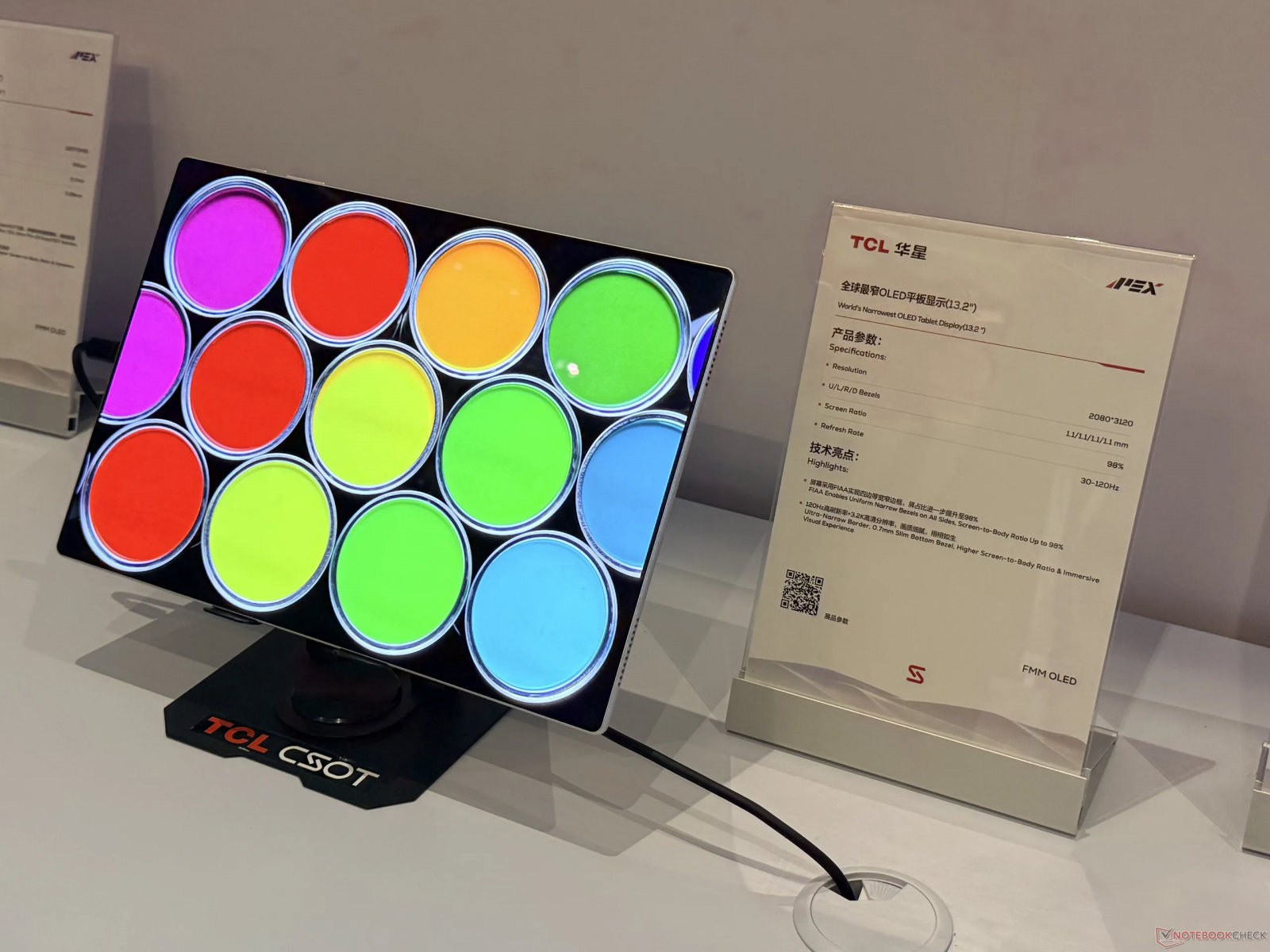
A 98% figure on a display prototype should not be read as a guarantee for a retail tablet. Device makers still need room for structural rigidity, display protection, and a grip area that reduces accidental touches. Those considerations can require larger borders once a panel is integrated into a finished chassis.
A component roadmap, not yet a TCL tablet announcement
The concept also differs from TCL’s NXTPAPER 14 and NXTPAPER 11 tablets, which emphasized anti-reflective, paper-like viewing. This OLED effort is centered instead on shrinking the physical footprint around a large display. As a panel supplier that also works with other device makers, TCL CSOT could see this technology appear in hardware from a partner rather than in a TCL-branded tablet.
TCL CSOT is reportedly in discussions with industry partners, and the first commercial tablets using the panel could arrive in 2027. There is no confirmation of volume production, participating brands, pricing, or U.S. availability. For now, the prototype is most relevant as a preview of how manufacturers may pursue bigger usable screens in premium portable devices while keeping their dimensions in check.
Post Footer automatically generated by Add Post Footer Plugin for wordpress.