The foldable market’s center of gravity is shifting toward phones that unfold into compact tablets. Counterpoint Research expects global shipments of foldable smartphone display panels to rise 23% in 2026, with book-style designs accounting for an increasingly dominant share of production.
That is a meaningful distinction for anyone reading the market numbers: panel shipments measure displays supplied to device makers, not foldable phones sold to consumers. Still, the forecast points to manufacturers placing their biggest bets on the larger-screen form factor, rather than the compact flip-phone designs that have helped make foldables more familiar.
Large foldables pull away from flip phones
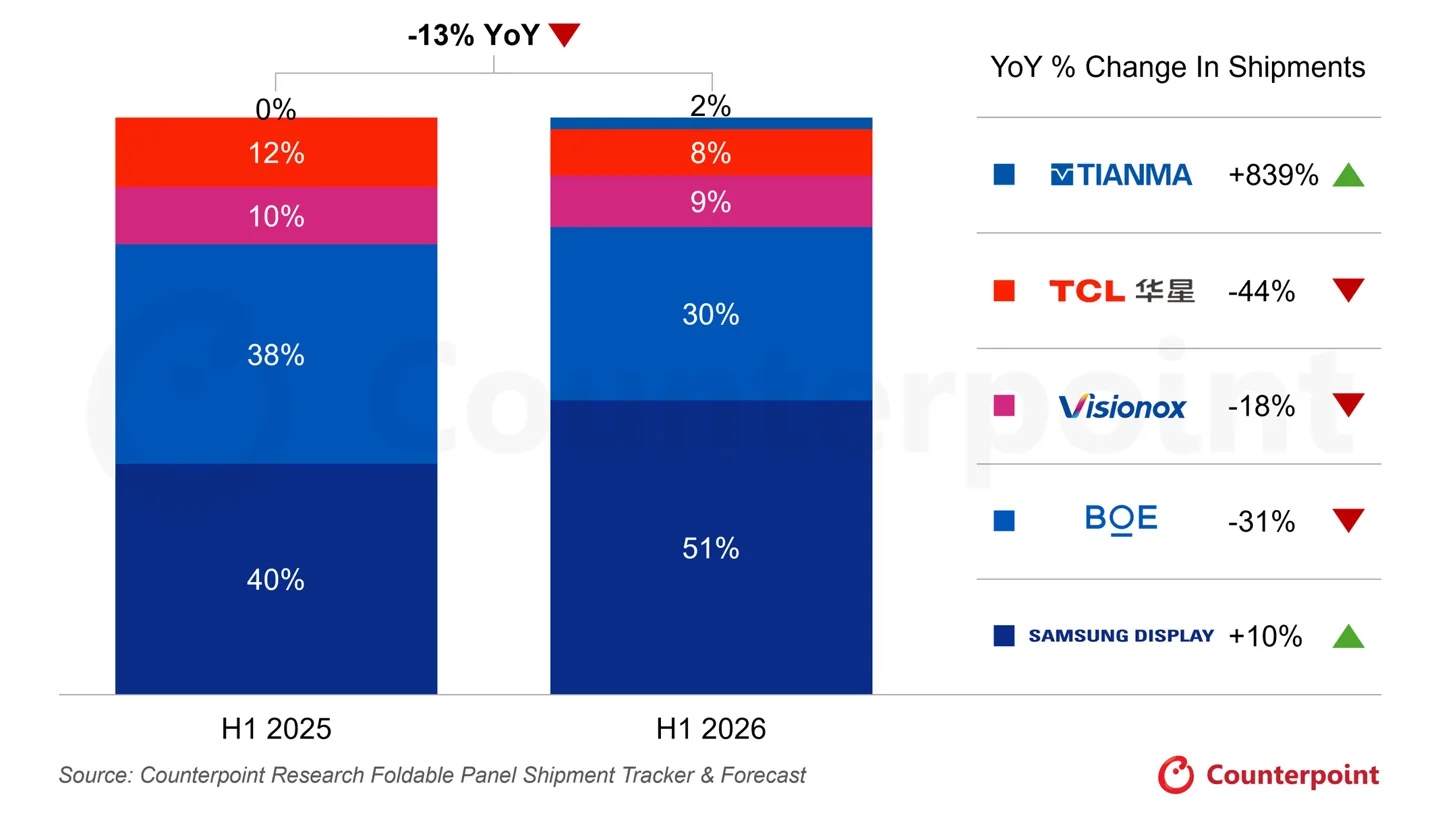
The first half of 2026 was weak overall, with foldable-panel shipments down 13% from the first half of 2025. But the total masks a sharp divide between the two main designs. Book-style panel shipments rose 35% during the period and represented nearly 80% of volume in the second quarter, while clamshell-panel shipments fell 62%.
- Book-style foldable panels are projected to grow 107% for the full year and reach 81% of the market.
- Clamshell or flip-style panels are forecast to decline 59%, leaving them with a 16% share.
- Multi-fold displays are expected to remain a niche category at roughly 3% of panel shipments.
Counterpoint expects the year’s production to be heavily weighted toward the second half. Panel shipments in the latter six months of 2026 are forecast to rise 53% from the first half and 71% from the second half of 2025, accounting for 61% of annual volume.
Apple could become a major panel buyer
Apple is forecast to account for 27% of foldable-panel shipments in 2026, with all of its projected panel volume arriving in the second half of the year. The company has already officially introduced the iPhone Duo, according to the report’s underlying information, moving Apple’s foldable plans beyond the rumor stage.
Samsung is still expected to be the largest purchaser of foldable panels at 33%, followed by Apple at 27% and Huawei at 25%. The concentration illustrates how dependent the emerging category remains on a small group of manufacturers capable of supporting high-volume production of flexible displays.
Those panel figures should not be confused with forecasts for foldable handset shipments. A separate Counterpoint projection placed Apple at 25% of foldable phone shipments in 2026, behind Samsung at 38%. The difference reflects two different measurements: displays ordered by manufacturers versus finished devices shipped into the market. For buyers who see foldables as a way to carry a larger workspace or entertainment screen without bringing a tablet, the data suggests book-style models will increasingly define the category; U.S. pricing and availability details are not included in this forecast.
Post Footer automatically generated by Add Post Footer Plugin for wordpress.