Apple’s M6 may bring the kind of CPU jump that matters for compact desktop and mobile workflows, if an early Geekbench 7 submission proves representative. The unverified result, identified as a Mac mini, records 4,071 points in single-core testing and 22,783 points in multi-core testing. That places the base M6 within 545 points of the M1 Ultra’s reported 23,328 multi-core score—a striking generational comparison, though not evidence that a base Mac mini replaces an Ultra-class system.
The comparison is limited to CPU testing. M1 Ultra belongs to a substantially different class of SoC, with greater graphics, memory, and sustained-workload resources. Likewise, the single benchmark run cannot establish how the M6 performs across real applications, repeated tests, or longer workloads.
A larger CPU configuration helps explain the gain
The Geekbench entry identifies the system as Mac18,5 running macOS 27.0 with 32GB of unified memory. It lists a 12-core Apple M6 processor and a 4.78GHz base frequency. Apple has not presented that clock speed as an official specification, so it should be treated as a benchmark-database reading rather than a final product spec.
Apple’s announced CPU design splits those 12 cores across three groups:
- 2 “super cores”
- 4 performance cores
- 6 efficiency cores
That is two more CPU cores than the M5 configuration used for comparison. As a result, the apparent multi-core improvement is not solely a measure of architectural efficiency, manufacturing process changes, or instructions-per-clock gains; more cores are contributing to the result.
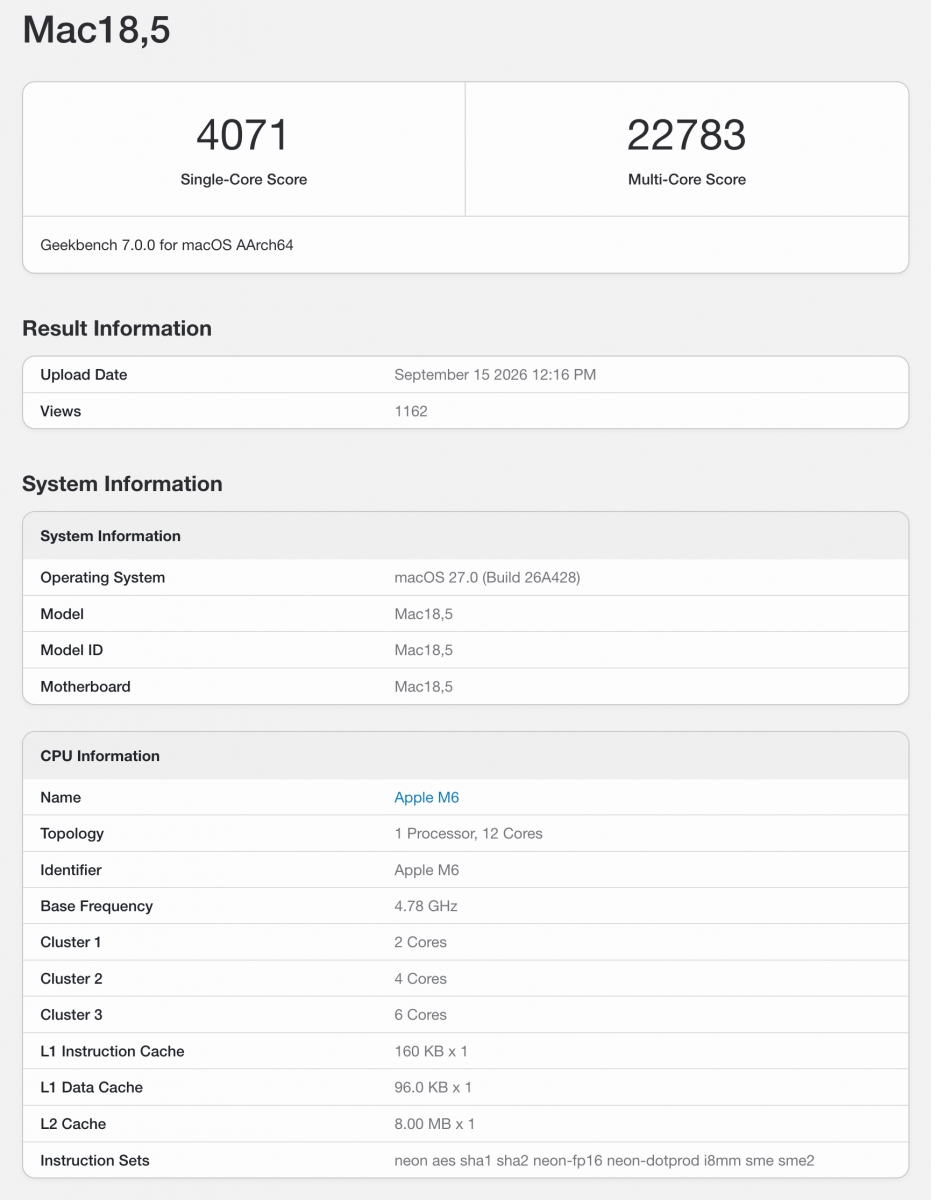
| Chip | Geekbench 7 single-core | Geekbench 7 multi-core | M6 comparison |
|---|---|---|---|
| Apple M6 | 4,071 | 22,783 | — |
| Apple M5 | 3,641 | 17,948 | M6 is 11.8% higher single-core and 26.9% higher multi-core |
| Apple M5 Max | 3,731 | 35,119 | M6 is 9.1% higher single-core |
| Apple M1 Ultra | — | 23,328 | M6 is 2.3% lower multi-core |
The M5 figures are Geekbench 7 averages cited by MacRumors, while the broader comparison uses representative scores for the other chips. These numbers are useful for broad positioning, not for declaring narrow benchmark victories. Still, the 26.9% multi-core lead over M5 exceeds Apple’s stated claim of up to 1.2x multi-threaded performance versus the prior chip in this one result.
GPU and local AI performance remain untested
Geekbench’s early result covers CPU performance only, leaving out much of Apple’s M6 platform story. Apple says the chip includes a 12-core GPU, neural accelerators in each GPU core, two 16-core Neural Engines, and up to 170GB/s of unified-memory bandwidth. No M6 GPU result had appeared in Geekbench 7 when the CPU entry was published.
Geekbench 7 also uses a different methodology from Geekbench 6, including changes to how some multi-threaded tasks are handled. Scores from the two versions should not be mixed in a single ranking.
Apple’s M6 Mac mini is scheduled to begin shipping September 22, with a 12-core CPU, 12-core GPU, and up to 32GB of unified memory. Broader testing will determine whether this CPU result holds up—and whether the M6’s graphics and local-AI hardware deliver comparable gains for creators and other users who need more than short synthetic benchmarks.
Post Footer automatically generated by Add Post Footer Plugin for wordpress.