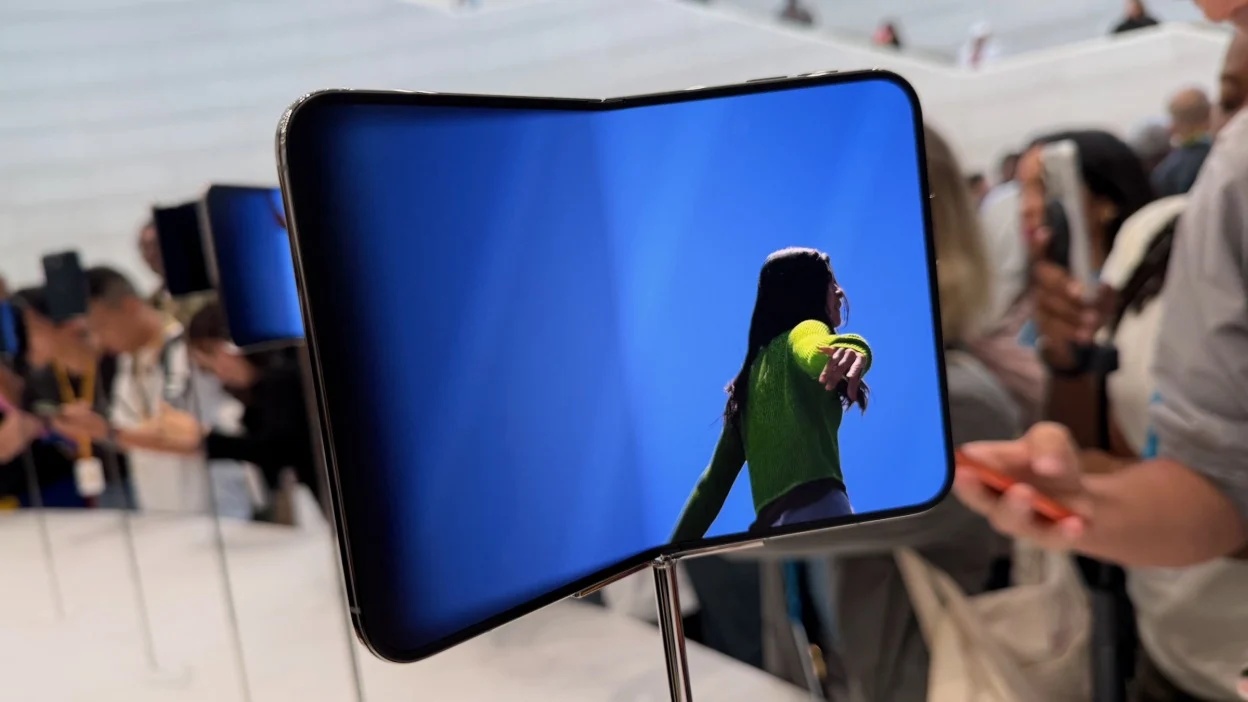
Apple’s first foldable phone may have found its clearest demonstration of the form factor in a few seconds of motion. When the iPhone Duo is unfolded, the interface appears to continue from its outer display onto the larger inner screen rather than simply shutting off one panel and activating another. The effect uses blur, depth, scaling, and timing to make the changing shape of the device feel like part of the app experience.
That transition has quickly become a focal point of early reactions to the iPhone Duo, drawing attention alongside the hardware itself: a hinge with more than 100 components, a 7.6-inch internal display, and an under-display camera. Those are meaningful pieces of a first-generation foldable, but the opening animation is the detail viewers have repeatedly shared.
The crowd favorite is the animation when you open and close the phone.
Marques Brownlee
Brownlee separately posted the animation, and clips of the effect spread rapidly across X, YouTube, and Instagram. Gizmodo’s Raymond Wong similarly highlighted the transition after using the phone, suggesting that Apple’s implementation stands out because it avoids the visual impression that an app is being handed off between two unrelated screens.
I can’t get the transition animation out of my head.
Raymond Wong, Gizmodo
A hinge becomes a software input
The animation is not just a visual flourish. Apple says iPhone Duo apps can receive continuous information about the hinge angle as the device opens or closes. That lets software reposition controls, avoid the fold, and respond to the phone’s physical posture. In that context, the widely shared transition is the polished front end of a broader approach: treating the hinge as an input for app behavior, not only the mechanism joining two display halves.
Foldables from Samsung and other manufacturers have spent years addressing the category’s familiar hardware challenges, including hinge durability, creases, secondary displays, and multitasking. Apple is arriving later to the category, but the iPhone Duo’s early attention illustrates how much a carefully designed software transition can affect the perceived coherence of a folding device.
A Galaxy Z Fold8 recreation suggests the hardware is ready
The iPhone Duo effect may not be difficult for rivals to replicate. A Galaxy Z Fold8 user recreated a similar two-screen transition by using the handset’s hinge-angle sensor to control the animation. The Reddit post received more than 14,000 upvotes, making a straightforward point: the necessary sensor data is already available on competing foldables, and a comparable experience could be delivered through software.
That does not make the iPhone Duo animation less effective. For prospective foldable buyers, it is a compact illustration of a larger usability goal: a device that feels like one expanding workspace rather than two displays taking turns. Whether Samsung, Google, and other foldable makers adopt similarly hinge-aware transitions remains unknown, but Apple has given the category a highly visible software detail for competitors to consider.
Post Footer automatically generated by Add Post Footer Plugin for wordpress.